Sunday, August 13, 2023

The Sky Hotel

https://www.youtube.com/watch?v=ZrodDBJdGuo

It's impossible screams everyone!!! Well, as of 202X, the video's design and technological base is. 

But the concept is cool, what's the feasibility with technologies that appear quite possible to us in the current day?

1) Perpetual Power (Nuclear) - this is probably the core of the concept. Nuclear power is so dense and powerful that it enables ideas that simply aren't possible with what we think of in terms of oil / gas / chemical rocketry. Here's a good little primer: 

https://energyeducation.ca/encyclopedia/Energy_density

The money diagram is "table 1" under fuel energy density. UM, how many more zeroes is that? Yes, nuclear power is 100,000 times more dense. 

But currently used fission nuclear reactors are huge behemoths. The fusion nuclear reactor in the article is pure fantasy, the ITER in France, the preeminent jewel of sinking fusion reactor research dollars, is 1000m x 400m.

The easy part of nuclear concepts is the effectively unlimited range, because the density of the fuel is so high. The challenge for nuclear vehicles is getting a compact reactor that produces power/weight ratios, and oh yeah, making it safe for occupants of a vehicle.

As part of the Air Force nuclear bomber project (where the Air Force would have a long range bomber aircraft that could deliver bombs and would rarely / never land), the Oak Ridge National Laboratory designed several key reactor concepts:

https://en.wikipedia.org/wiki/Aircraft_Reactor_Experiment

I believe the key number here is a targeted 350 megawatt powerplant for the eventual production reactor, but that was never fully developed. The ARE reactor was only 2.5 megawatts, and was the last one before the project was cancelled due to funding concerns by John F Kennedy. 

Essentially, the LFTR/MSR reactor design underpinning the Air Force's nuclear bomber could drive very high temperatures, which is important in aircraft because it means that brayton cycle engines (which is the engine cycle of turbofans) can be used for high efficiency power output. The Air Force had confidence that the design would lead to a high speed, high-endurance, long range (perpetual range) bomber aircraft.

Of course, the military has less concerns around crew safety and nuclear pollution than non military (especially the Soviets who were also working on this concept). Billions of dollars of research would likely be needed, but the fundamentals are there. Modern aircraft engines output 50 megawatts at peak liftoff. A 350 megawatt reactor would be able to do perpetual peak power output for seven of those.

But this was also almost 75 years ago. 75 years of aircraft design, materials engineering, reactor operation, etc. And the aircraft reactor experiment is fundamentally very scalable in size: from a closet-sized reactor to much larger ones as needed.

Essentially, the core power generation and perpetual flight aspects of the nuclear sky hotel are very much feasible in physics theory and in technology. The real issue with any nuclear reactor feasibility is the cost of development (billions) and the safety (we'll get to that).

2) Airframe design

Who knows if the video's actual shape/design is feasible. There is a joke that with enough power a pig can indeed fly.  Let's assume from what seems feasible in the nuclear power feasibility that we have enough power to make any reasonable air wing of any size fly. Fundamentally an airbus A380 is a big bulbous glob with wings, and it flies quite well! Other examples like the Antonov AN-225 and other military transports show that you can make quite a lot of large shapes as shown in the video fly close to Mach 1.

https://www.flyingmag.com/comparing-the-worlds-largest-airplanes/

There is also the concept of the big massive flying wing, the most common concept is the B-2 stealth bomber. Essentially, you gain efficiency by making the entire plane a wing, and if the plane is big enough, the wing is where people stay in the plane. Flying wing concepts are in heavy development in the aerospace world in order to gain efficiencies for lowering carbon impact of air travel. For example, here is the "blended wing" concept from airbus:

https://www.wired.com/story/airbus-maveric-blended-wing-jet/

It doesn't take a lot of imagination to scale that out and the wings become part of the passenger accommodations. 

And if we are talking about massively sized aircraft, there is also something else that can be integrated into the design: the fact that blimps/airships improve in efficiency and capability as they get bigger. If we are going to talk about a massive flying machine, then we are already moving into the scale that using airship techniques could also improve feasiblity, especially in the economic sense.

So the essential question: can you make something that big fly? Yes. Very achievable with just a propelled plane, and very much with an airship.

Making big airplanes fly was basically solved in the era of bombers by the air force and air travel industry. Airplane size tops out at the current sizes not because of physical or engineering limitations, it is simply a matter of economics first, and secondly infrastructure for landing them.

3) Infrastructure / Facilities

The essence of the concept however is the fact it doesn't ever land in practical terms. This is of course unrealistic. Some total overhaul would be necessary. Perhaps if, like the cruise ship and transport industries, so many were built that eventually a practical maintenance-free or maintenance-lite design was conceived. 

But aside from the "hotel" aspect is all the uses of large ocean ships come to mind. Passenger ships are point-to-point destinations. The longest commercial flight is 19 hours and 10,000 miles roughly. However people would likely pay a lot more to travel in hotel or near-hotel conditions and get there in 24-36 hours instead, assuming a slower speed. 

Likewise, priority cargo transport would be point-to-point and involve landing and unloading. In reality, this is what would stimulate the construction of ground facilities for landing.

The obvious approach would be it would never land ... on land. It would land on sea. There are some pretty big planes that can take off from water:

https://en.wikipedia.org/wiki/AVIC_AG600

A sea-based landing would remove a huge infrastructure cost of making someplace for it to land. 

As for loading/unloading of a perpetual flying hotel, this is where a mixed airship/airplane design comes into play, because it enables two things:

First, it enables the aircraft to possibly slow down to very slow speeds safely. If the airship's can slow safely to 40-50 mph, that is a very doable speed for "drops" or hooked cargo catches or some other handoff scheme. Those speeds would also be feasible for helicopters, and dirigibles to catch up and dock.

Second, if there is an airship aspect, there would be room for a landing strip for planes or helicopters/VTOLs. Because the flying hotel is already moving at decent speed, the length requirements are lessened for takeoff and landing. Aircraft carrier techniques could also be employed with snag cables and catapults.

4) Safety

Well, it has a nuclear reactor. A reader may not know this, but a MSR design from the aircraft project is fundamentally safer than nuclear reactors in use for power generation, because they do not use solid fuel rods. The liquid fuel can turn off/remove criticality of the reaction on demand. 

But we still have the issue of crashing. We can armor the reactor, but for a crash on land? The obvious solution is that the plane never goes over land for any substantial time. For nuclear waste, water is an excellent shield, so if the reactor from a crashed megaplane sunk into the ocean, it is automatically well shielded. 

Perhaps if certain key crossings, like the Panama crossing or something similar, could result in a land crash, but planes can glide for as much as 60 miles and the Panama crossing is less than that. A crossing would be attempted only if the plane was in good operation.

That would leave catastrophic failure/crashes in only certain small sections of land, and that can obviously be mitigated by making them over nonpopulated lands.

As for the AI turbulence, it isn't clear to me that this would be needed. Bigger planes experience less turbulence effects per this seemingly very thorough analysis:

https://www.quora.com/Does-the-size-of-an-airplane-affect-the-amount-of-turbulence-a-passenger-feels

Sky hotel / passenger transport would likely target slower speeds at cruise, probably 300-400 mph, although nothing about the nuclear aircraft experiment suggests that a high speed couldn't be engineered. The perpetual range aspect means the aircraft could simply fly around bad weather, while the fuel efficiency aspects of air transport means that planes will simply fly through bad weather. 

5) Economics

Okay, well, who knows with this. Something like this could only be budgeted if there was existing economies of scale and interests aligned. That would probably  require:

- a very robust and mature market for LFTR / MSR nuclear reactor designs in commercial/civilian operation and probably the US navy moving its nuclear reactors from the current design to a LFTR design

- the US military taking extensive interest in a rapid mass transport of cargo / military hardware by sponsoring the initial nuclear mass transport aircraft

- a very reliable market for very affluent customers using this transport mode, for people willing to spend likely 10,000$ per trip or experience, and possibly more.

While the availability of rich clients is feasible given what is being seen with space tourism, something like the sky hotel is not happening without especially the development of the LFTR/MSR in very wide use with multiple generations of refinement, and currently there isn't even a commercially operating MSR, although China is bringing a MSR online very soon. 

This likely would take a grand military investment and revitalization of the MSR inside military/national laboratory/US government with sustained funding. There is new MSR funding coming in the national laboratories, so there is hope.

It may also require the success of large cargo-transport airship startups to achieve commercial viability. That would produce large scale airships and airship infrastructure that could be one-offed/enhanced to achieve the "air cruise ship". 

It may also require a host of advancements in materials engineering such as extremely cheap carbon fiber or graphene/nanotube strength materials to vastly reduce the weight of the frame.

Something like this only happens as a side interest to a fundamental shift in the logistics industry, where nuclear power produced a significant economic reduction in the speed and cost of transporting things that petroleum or other schemes couldn't compete with. It would only happen as the brainchild of some multi-hundred billionaire who likely made such riches in successive stages of the underlying revolutions necessary in nuclear technology and airship/air transportation.

Thursday, December 2, 2021

 End of 2021: Opinions on EVs

2021 has been almost the year of the EV. Well, more of the year of the 'announced EV'. This is the year that every major manufacturer has publicly committed to EV transition, by choice or by threat of firing (see: ex-BMW Kruger squandering his company's nascent EV advantages)

So what do I see as the major technological themes to completing the transition to EV that are currently important and in flux?


EVs are basically huge battery banks with steering wheels. The most important aspect of transportation electrification is the technological development of the battery.

Tesla's batteries, more or less the state of the art for scaled production, are currently two-tier: NMC batteries that require cobalt (the C in NMC) and nickel (the N in NMC) for all the sexy and long range vehicles, which likely won't change for the foreseeable future beyond packaging like the 4680 cell and reductions to cobalt. Sourcing of cobalt and nickel (especially cobalt) is pricey and amoral (child labor, bad conditions, etc). More importantly, for EVs to scale by a factor of 100 to supplant ICE, there just isn't the sourcing for enough NMC.

What is more interesting is their low-end Model 3 now has LFP chemistry.

LFP (L is lithium, F is Fe/Iron, P is phosphate) is a cheap, scalable, safe, near-infinitely-rechargable, wide temperature range chemistry that unfortunately is not as energy dense (and EVs are all about getting as much energy as you can into the car). However they require less cooling and other systems, so at the integrated system levels, they "catch up" to NMC cells enough to enable a cheaper 200 mile Model 3.

LFP can be very well scaled and is already in wide manufacturing. Most importantly, LFP is poised for substantial improvements in density that could bring it into range of current NMC cell density at the overall system/pack level. CATL and other chinese suppliers have roadmapped a rise from 170 Wh/kg density to 200 in 2022 and 230 after that. Higher density is also less weight, so the same energy capacity battery goes further with a smaller physical weight, or the same weight battery goes 20% to 40% further.

And cheaper, safer, better recharge cycles. All good stuff.

Higher capacity LFP also improves e-bikes, e-motorcycles, e-anything. It'll all go further. E-tools like electric lawnmowers will fall under gasoline in price, which is super important given how polluting two cycle engines are.

LFP  is the key to getting cheap batteries in a very very very wide range of applications.


EV charging infrastructure is the next big thing. Tesla has its own network. Currently based on what I can tell, it's the only network you can rely on to have functioning chargers that will connect and charge, with enough buildout.

All the other charging networks are terrible. Which is terrible news for alllll those dozens of EVs that non-Tesla makers will be pushing out.

But I do think that the EV charging infrastructure will rapidly improve on a quarterly basis. There is government oomph, it is pretty easy to get chargers installed, and you can put them basically anywhere: streets, parking garages, parking lots, gas stations, car dealerships, or dedicated sections.

EV charging is the key to filling out the map for EVs. The speed is somewhat secondary, availability and coverage is the first priority, and I think 2022 will be a big year.


Some may wonder about solid state. Solid state is still a bit hard to tell. What I've been able to discern is that it isn't too hard to make a really small cell with solid state that looks good for investors/VC and get money.  The problem is getting a cost-competitive car-sized battery scaled from the wristwatch-sized prototype, with cycles, recharge speed, temperature range, density, and cost all better than the wet cells.

Quantumscape allegedly showed a "10 layer" cell recently, but there hasn't been much "wow" in the press. Probably because the scale is still wayyyyy to small, its not near production, and who knows about the cost.

Solid state however is VERY important to all EV makers that aren't named Tesla (or maybe Lucid).  These companies are currently 3-10 years behind Tesla in technology and will have second-rate EVs for the near term. What can close the gap? A paradigm shift in battery density and cost. The only thing out there is solid state.

There are companies like Stellantis, Mercedes, and all the japanese makers and others that are WAY behind Tesla. Ford, VW, GM, and maybe BMW have made the first steps. These companies will lose major market share, or cease to exist, unless Solid State saves their bacon.  Right now, nobody knows if this will happen.

So solid state is still a bit question mark.


What's irritating about the car press is that they don't realize how almost every car manufacturer can release lots of EV models, but none of them will hit large numbers. Likely Tesla will continue to sell more EVs that all other makers combined in 2022, because 1) Tesla will scale their battery production quite a lot between Austin and Berlin factories and expansion of China, and 2) the rest of the battery supply for the other companies, all procured through suppliers, isn't that big. These are all still research/toe-dipping endeavors, even if entire "marques" like Cadillac, Hummer, and Polestar are "all electric". Well yeah, but they also won't sell anything close to what Tesla is putting out there with the model 3 and Y.

2022 should be a scale jump by Tesla. It'll be interesting to see VW and GM next, who are the next furthest along, what they scale to. As referenced above in LFP though, Tesla is the only western car maker that has the drivetrain efficiency tech to do LFP. Maybe Lucid does as well,  but they are so so so so small right now.

Tuesday, October 25, 2016

CO2 in the atmosphere: One quadrillion dollars

I was thinking about economics and the "real price" of things, and it's consistent failure to account for environmental damage in basic microeconomics in the real world. So I wondered: how much of a tax would we have to impose on gas sales to take care of the carbon it puts into the atmosphere, and also to start undoing what we've already put in?

Basic numbers to start:

How much carbon does a gallon put into the atmosphere?

A gallon weighs about 6 pounds.

Each carbon molecule (nuclear weight about 12) in the hydrocarbon combines with two oxygen molecules (about 15-16 nuclear weight about 15). That number based on chemistry becomes 21 pounds. Turns out it's about 20 pounds officially.

So 1 gallon = 20 pounds of carbon

How many tons of carbon are in the air?

A lot of googling got me to the point that there has been a 40-50% increase in CO2 in the atmosphere since the industrial revolution, and that there is about 2700-3000 trillion tons of CO2 in the atmosphere.

So humans are responsible for about 1-1.5 trillion tons of CO2.

How much does it cost to remove a ton of CO2?

http://news.stanford.edu/news/2011/december/extracting-carbon-air-120911.html

That seems to indicate it costs $1000/ton to remove.

Ouch. So the cost to remove the carbon industrially is 1 QUADRILLION DOLLARS or more.

1,000,000,000,000,000.

That's a billion million dollars. Or a thousand million million dollars.

Since 1 gallon produces 20 lbs which is 1/100 of a ton, that means every gallon to break even should carry a $10 surcharge to be carbon neutral.

If you wanted to tax additional removal, with that big a hole, we should impose another $20.

... gas wouldn't remain a means of power generation very long at those costs.

As fun as punitive costs are to dream about, we have the real problem of the 1 trillion tons of CO2 to remove.

$1000 a ton seems like a lot, and it is really the only flexible component of the whole equation. We need technology to reduce the costs:

- algal biodiesel or algal fertilizer / livestock feed conversion?
- greening the sahara?
- iron seeding of algae in the ocean?
- industrial process?

What we really need is a factor of a hundred improvement here. 100 trillion dollars is possible but hard. 10 trillion dollars is doable.

But keep in mind that a 100x reduction in carbon removal cost, using for example algal biodiesel production, would mean that we could produce biodiesel that is ten cents a gallon...

Keep in mind the GROSS WORLD PRODUCT in 2014 was 77 trillion dollars.

Algal biofuel, based on their engineering goals is to produce $3/gallon biodiesel. Since we can assume roughly 20 pounds of CO2 is removed from the air to produce that, that means biodiesel cost to remove a ton is $300. Each square mile could produce enough biodiesel to remove 50,000 tons of CO2 per year.

If we wanted to do 1 trillion tons per 20 years, we'd need 1 million square miles, or 1000 x 1000 miles. So 1/3 of the Sahara. Yikes.

We might as well green the sahara. How much carbon dioxide does a square mile of forest remove from the air?

Some article says: temperate forest per hectare offsets yearly emissions of "300-400 cars" where a car generates ~ 5.5 tons / year. 280 hectares/square mile... hm, that's 500,000 tons/sq mile. that's 10x what we'd get from biodiesel farms.

So we'd need to create 100,000 square miles of temperate forest to do the job?

Which is about the size of arizona.

http://io9.gizmodo.com/5360952/geohackers-want-to-transform-the-sahara-into-a-forest

Two trillion dollars a year to remove eight billion tons of carbon per year, according to that. To remove almost a trillion tons is roughly 200 trillion dollars by that calculation...

TODO: use nitrogen fixation costs for fertilizer/ammonia production to guessimate an industrial process cost to remove CO2.

https://en.wikipedia.org/wiki/Carbon_dioxide_scrubber

I suspect what is necessary is a multi-headed approach:

- taxation on gas
- massive rollout of alternative solar / wind / nuclear (MSR/LFTR or other designs)
- desert greening
- algal biodiesel research "Manhattan project"
- ocean seeding research
- industrial process for Carbon fixation "Manhattan project"

Monday, January 14, 2013

The Negative Sum Game

It's a undead, gasping dystopian future that lives in our present world.

It has a fantastic marketing department.

And right in the USA.

You want to know the end state of the human economic machine? It's a plane trip away. You might even be convinced you're having fun doing it.

It's Las Vegas. The living, breathing Negative Sum Game, sucking life and energy from the world.

Of course in the purely mathematical sense, you have the raison d'etre of Las Vegas... the embodiment of the negative sum game... all gambling games of the flashing neon casinos are guaranteed to the house. You'll win some, but eventually you'll lose more.

But there is also the black hole of economic strength that Las Vegas feeds upon, sucking up the energy and human production extracted from resource exploitation globally, concentrated in the rich, who then travel to Las Vegas to spectacularly, conspicuously, and vapidly expend it in the barren sands of Nevada.

Las Vegas itself rises from the desert, and sucks in ungodly amounts of increasingly precious freshwater to create false visions of lush paradise. Even high up in the hotel towers, a wall of concrete mostly obscures the surrounding arid terrain. Energy burns lighting the city day and night, as the cogs of the industrial gambling machinery lubricate themselves on the blood and sweat of millions.


The economic model of Vegas is as a millenium ago, or perhaps in a millenium as the resource riches of the twentieth century fade from memory. An entire city dedicated to the pursuit of the entertainment of the top 1%, or those pretending to do so for a very short period of time, supported by hundreds of thousands of servants bussed in day and night.


So sinister is the subtle dessication of the soul Vegas imposes upon its visitors.

At its heart the amusement offerings of Vegas lull you into inactivity. Sit here, and gamble. Sit here, behold a glittering show. Sit here, and eat this dinner. Sit here, and gamble some more. Sit here, and inebriate. Sit here, by the pool. Sit here, to be seen. Sit here, and be writhed upon.

Okay, we'll let you walk a bit, if you want to shop.

Whatever you wish, do not wish for activity. It's truly a gilded prison, this place, with no real escapes. You are surrounded on all sides by a wasteland of concrete. That is surrounded by a wasteland of desert. The monorail only monotonously moves to another carbon copy of a casino.

No forests, no rivers, no fields. No roads to ride, no trails to hike or run, no bodies of water to swim or surf. No wildlife. No plant life.

Are you not entertained?


Sunday, January 13, 2013

Teenagers are useless: Why?

Teenagers in modern America are almost completely worthless. Here's what they are good for economically:

1) stimulating consumer demand by forcing parents to buy them plastic crap
2) exposing their parents to new technology
3) playing sports for parents to blindly cheer

... and that's about it. Maybe when they're 20 they'll be able to do something, but our civilization basically takes teenagers, drops them in a padded cell for about eight years, and does nothing but force mindless repetitive memorization upon them.

I think one of the great untapped resources of education are the students themselves. Need to teach a fifth grader about whatever it is they make a fifth grader memorize (disclaimer: I am not an education professional)? How about a sixth grader? They just learned it.

Schools have a real problem rewarding academic achievement. What does school reward effectively?

Athletic prowess.

No, this isn't going to be a screed against dumping football from high schools. No, instead, let's look at how sports work and reward athletes. Hint: it's about mentorship.

Does the coach of a team teach every single athlete every single thing about their sport? Hell no. I'd completely unscientifically guess that 75% of sports skills is learned by mimicking and following the better athletes of team, and practicing those skills with an against them. Sports are still heavily organically learned via practice and game situations.

And athletes inevitably look up to the athletes only a grade or two better than them. Or even if they are younger or the same age, if they are better. Why? Because being around them makes them better.

So if after every year, you have educated an entire class (well, based on what I see in modern academia, maybe 50% at best) with an entire year's knowledge, then you send them off to the next grade. Also, there is almost zero skill development in curricula, especially in teach-to-the-test curricula.

Seems like a waste to me. Hey, how do people really learn things? By being exposed to it, and then using it in some way. Problem with 90% of high school knowledge is that it isn't particularly applicable immediately.

Oh, but what if older students could be given a system and structure to teach this knowledge to younger students? You don't really learn something really well until you teach it to someone else.

A systematic process of using teenagers (the better ones) to teach people a grade or two younger would provide a lot of benefits:

1) Provides a leadership function to those with academic prowess
2) Helps provide socialization development and interaction skills both for the mentors/tutors and their students
3) Helps create community among students and grades
4) It's cheap, virtually free labor
5) it strengthens knowledge in the teachers and students
6) provides another source of learning besides droning adults
7) provides roles and responsibilities to teenagers who really have little other value to society in terms of labor and expertise
8) Hopefully provides peer social status to academic achievement

You don't even need the best-of-the-best-of-the-best to do this. I'd guess the top 20-40% of a grade one to three levels ahead (12th teaches 10th or 9th or 8th grades) could provide effective teaching.

I think this would be especially effective in inner city schools. These schools often feature economically stressed families that usually rely on community support anyway, and not a lot of structure or reward for teenagers. Look at what gangs provide teenagers in these communities: a place, responsiblity, and often a position of mentorship for other teenagers. Unfortunately, all those laudable roles are devoted to criminal enterprises.

But drug gangs show that teenagers are willing, proud, and capable to do such things. Let's copy what works, folks.


The new Hanging Gardens of Babylon

Modern architecture is very disappointing.

For an allegedly forward-looking discipline, it seems to me that all they provide is a view to the past. Towards concrete and metallic monstrosities that show more of humanity's ability to extract from the earth, than to live within in.

Let's go by examples: Hey, why not the Architectural Digest hot projects of 2012?

Number one:

http://www.architecturaldigest.com/architecture/2012-01/best-architectural-projects-slideshow

.. not a goddamn tree in site. Edit: They messed this link up. Select forward and then go back...

Number two:

http://www.architecturaldigest.com/architecture/2012-01/best-architectural-projects-slideshow#slide=2

Ooooh, at least they have grass and water in that one. Is that "river" chlorinated?

Number three:

http://www.architecturaldigest.com/architecture/2012-01/best-architectural-projects-slideshow#slide=3

Is that a greenhouse without the green?

Number four:

http://www.architecturaldigest.com/architecture/2012-01/best-architectural-projects-slideshow#slide=4

I christen that the "skyshiv"

Number five:

http://www.architecturaldigest.com/architecture/2012-01/best-architectural-projects-slideshow#slide=5

... is that a building with an obese ring of fat? That is definitely a modern representation of humanity.

Number six:

http://www.architecturaldigest.com/architecture/2012-01/best-architectural-projects-slideshow#slide=6

Okay, grass on the roof, I can get with that. Not bad...

Number seven:

http://www.architecturaldigest.com/architecture/2012-01/best-architectural-projects-slideshow#slide=7

Would you like some concrete with your concrete? Make sure to light up the concrete... Well, it is a desert...

Number eight:

http://www.architecturaldigest.com/architecture/2012-01/best-architectural-projects-slideshow#slide=8

... the aliens have landed.

Okay, you get the point.

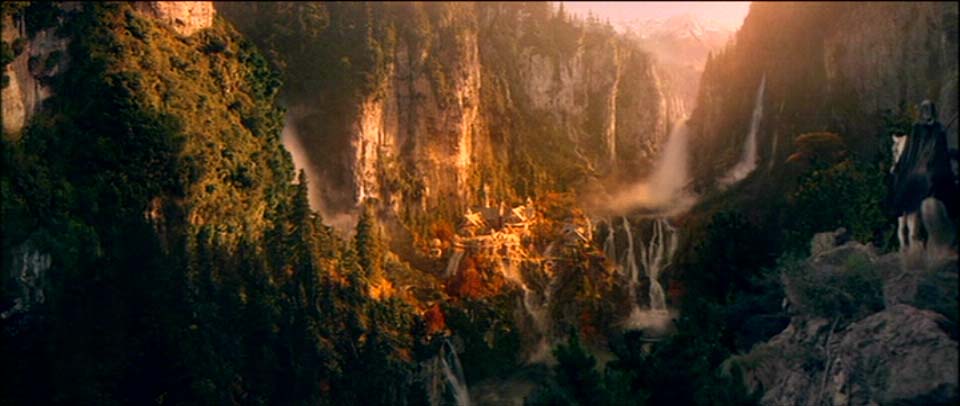
In the age of kudzu, inspiration, and infinite amounts of plastic construction materials, is it really so hard to imagine more organic yet amazing structures? I don't mean grass on the goddamn roof. How about Rivendell [http://ringtrilogy.tripod.com/lotr/lotr-28.jpg]? How about the Avatar home tree? How about towers that rise above a forest of trees rather than a sea of concrete, and connect above it?

Or, how about a modern Hanging Gardens of Babylon [http://en.wikipedia.org/wiki/Hanging_Gardens_of_Babylon]? Want to be a famous architect? How about you recreate something worthy of one of the moniker of the seven most famous architectural structures in history?

Immerse people in nature. It's clear that we will basically pave over the earth. How about architecture discovers ways of integrating our natural past into our technological present? How about a wetland that isn't just a disgusting mosquito farm?

We NEED nature around us, and not a couple trees sticking out of the sidewalk that drunken douchebag fratboys will mess up every weekend.

Create life. If people are willing to build a huge dome of glass, they'd be willing to do anything I've proposed.

Sigh, the CAD programs probably suck for this though.